
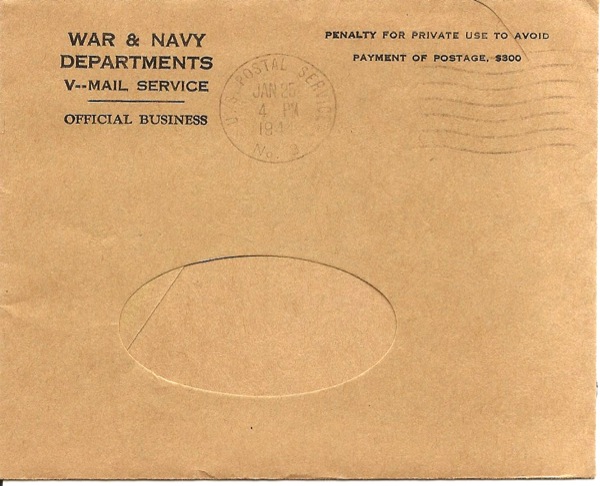

V-mail, short for Victory Mail, is a hybrid mail process used during the Second World War in America as the primary and secure method to correspond with soldiers stationed abroad. To reduce the logistics of transferring an original letter across the military postal system, a V-mail letter would be censored, copied to film, and printed back to paper upon arrival at its destination.
V-mail correspondence was on small letter sheets, 17.8cm by 23.2cm (7 by 9 1/8 in.), that would go through mail censors before being photographed and transported as thumbnail-sized image in negative microfilm. Upon arrival to their destination, the negatives would be blown up to 60% their original size 10.7cm by 13.2cm (4 ¼ in. by 5 3/16 in.) and printed.
According to the National Postal Museum, "V-mail ensured that thousands of tons of shipping space could be reserved for war materials. The 37 mail bags required to carry 150,000 one-page letters could be replaced by a single mail sack. The weight of that same amount of mail was reduced dramatically from 2,575 pounds to a mere 45." This saved considerable weight and bulk in a time in which both were hard to manage in a combat zone.
In addition to postal censorship, V-mail also deterred espionage communications by foiling the use of invisible ink, microdots, and microprinting, none of which would be reproduced in a photocopy.
